
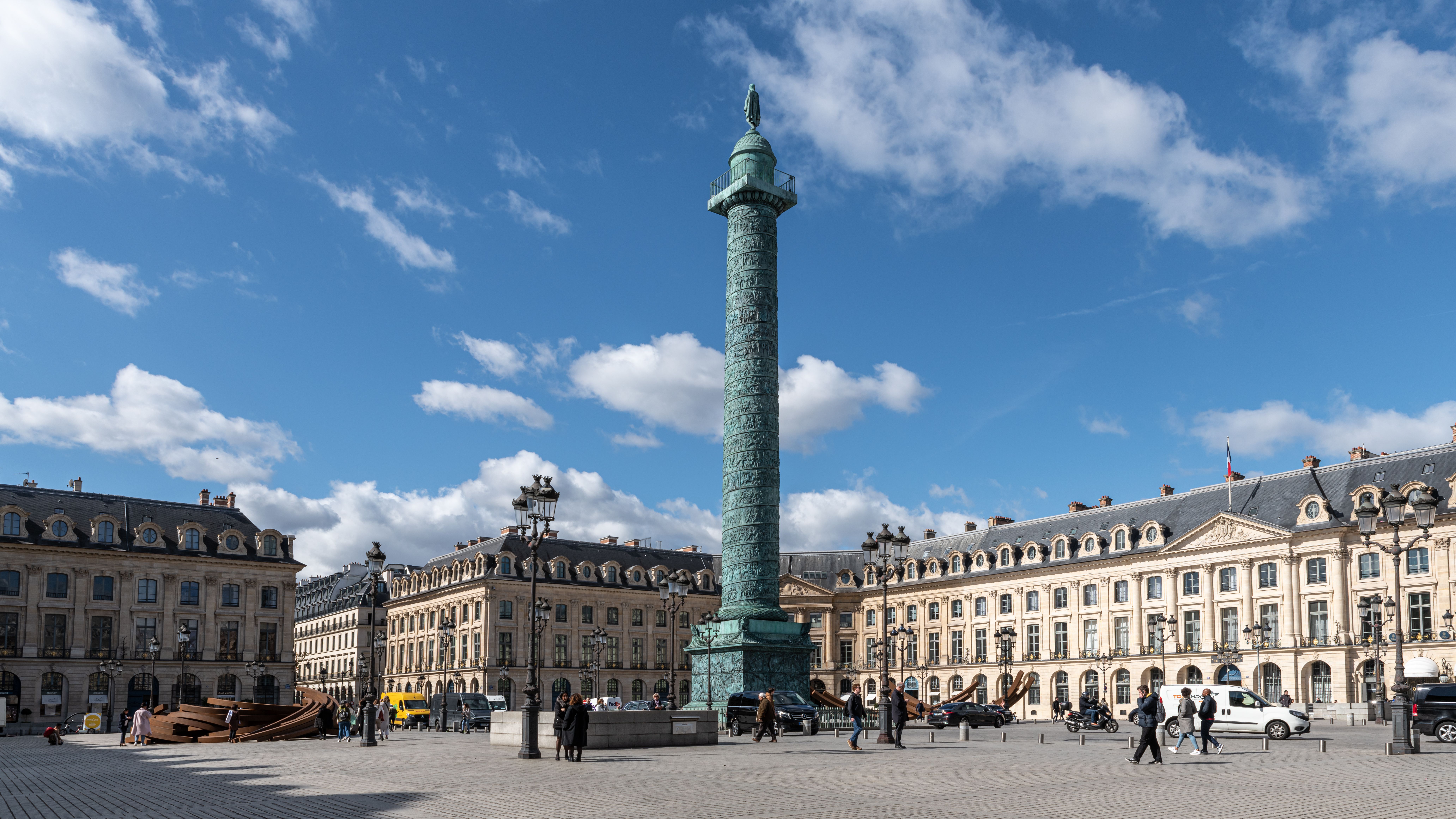
There are places in Paris you think you know because you have heard about them so often. Place Vendôme is one of them. But truly knowing it is something else entirely. It means understanding why Napoleon had his column erected there, why Frédéric Chopin spent his final days at number 12, why the world’s greatest jewellery houses chose this address and no other. The luxury experiences near Place Vendôme are among the most refined in the entire city.
Between the Tuileries, the rue Saint-Honoré and the Opéra lies one of Paris’s most historically and culturally dense neighbourhoods. Neither purely touristic nor reserved for insiders alone, it belongs to that rare category of places that reward curiosity. For those wondering what to do near Place Vendôme beyond the shop windows and the facades, here is what the neighbourhood only reveals to those who take the time to linger and why luxury experiences near Place Vendôme deserve more than a passing glance.
Place Vendôme : a First Luxury Experience in Paris
Before anything else, take a moment to simply be on the square. Not to cross it. Not to photograph it. Just to be there.
Jules Hardouin-Mansart designed it at the end of the 17th century with a symmetry that feels almost like a manifesto: everything is in its place, and this place is perfect.
The Vendôme Column, cast from 1,200 cannons captured at Austerlitz, rises 44 metres high. Napoleon modelled it on Trajan’s Column in Rome. What he obtained was something more distinctly Parisian: a kind of elegant defiance, planted at the centre of an octagon of blonde stone that the great works of the 19th century left almost untouched.
In the morning, before 9am, the square is nearly empty. This is the ideal hour. The light comes from the east, low and raking, making the facades shimmer with a colour that belongs only to Paris. The only sounds are pigeons and the distant hum of the city waking up.
It is in these moments that you understand why Coco Chanel chose to live at the Ritz for more than thirty years.
Jewellery, Art and History
You do not come here necessarily to buy. You come to understand what manual excellence can produce when carried across several generations.
The names engraved on the doors of Place Vendôme are institutions: Cartier, Van Cleef & Arpels, Boucheron, Chaumet, Mikimoto. Each has a history that extends well beyond jewellery itself.
Boucheron, at number 26, was the first jewellery house to open on Place Vendôme. In 1893, it chose a corner position that offered exceptional natural light for examining precious stones. This detail says everything about the attention to the smallest gesture in these houses.
The boutique is open to the public. Entering simply to look, with no intention to buy, is perfectly welcome and is an experience most visitors never consider. For those who wish to go further, the École des Arts Joailliers, supported by Van Cleef & Arpels, offers lectures, exhibitions and workshops on the history of jewellery, gemstones and artisanal craftsmanship. It is probably one of the most original experiences the neighbourhood has to offer.
Chaumet, at number 12, was the jeweller of Napoleon and Joséphine. The house holds one of the richest archives in French jewellery, comprising drawings, order books and historical pieces that bear witness to more than two centuries of history. A memory of French luxury that continues to inspire its contemporary collections.
Even without entering anywhere, walking beneath the arcades and studying the window displays is a lesson in aesthetics that no museum could replicate.
Gastronomy, Among the Finest Luxury Experiences near Place Vendôme
The Vendôme neighbourhood concentrates a density of Michelin stars that is exceptional even by Parisian standards. It is also one of the rare places where you can have lunch in a room inspired by Versailles, dine at a restaurant run by a triple-starred Japanese chef, and enjoy a hot chocolate in front of the Opéra Garnier.
Le Meurice, on the rue de Rivoli, perhaps embodies better than any other the idea of a Parisian palace. Its restaurant, led by Amaury Bouhours since 2021, holds two Michelin stars. The dining room, decorated after the Salon de la Paix at the Château de Versailles, is a visual experience in itself, even before the first amuse-bouche arrives.
Kei, on the rue du Coq Héron a few minutes away, offers something quite unique: high-level French cuisine reinterpreted by chef Kei Kobayashi, the first Japanese chef to earn three Michelin stars in France. The sauces carry the depth of the French tradition; the presentation reflects Japanese precision.
For something more relaxed without sacrificing the setting, Café de la Paix, on the boulevard des Capucines, has welcomed artists, writers, political figures and generations of travellers who understood that certain cafés are monuments as much as restaurants. The terrace, facing the Opéra Garnier, remains one of the most beautiful in Paris.
The Palace Hotels, Even Without Staying
The neighbourhood’s grand hotels were long closed to non-residents. Things have changed. Today, several open their bars, salons or gardens to outside guests.
The Hemingway Bar at the Ritz is worth a visit in its own right. Ernest Hemingway had his regular table there after the Liberation of Paris in 1944, and legend has it that he entered the hotel before the Germans had even left, in order to “liberate the bar.” True or not, the story says something about the place. The Ritz itself is worth stepping inside, if only to walk through its salons or glimpse its legendary interior garden. Few hotels in the world maintain such a close relationship with the cultural history of their city.
Culture and Heritage, Steps Away
Place Vendôme has the particular quality of being surrounded by some of Paris’s most important cultural landmarks, without this being visible from the square itself. A few minutes’ walk in any direction is enough to take it in.
The Opéra Garnier, ten minutes on foot, is one of those buildings you think you know because you have seen photographs of it. You do not truly know it until you step inside. Charles Garnier was thirty-five and unknown when he won the competition in 1861. The building he designed took fifteen years to complete. The ceiling of the auditorium, painted by Marc Chagall in 1964 on commission from André Malraux, creates a rare encounter between Second Empire grandeur and artistic modernity. You can visit the opera without attending a performance and it is often the best way to discover it.
The Tuileries Garden, to the west, is one of Paris’s oldest public green spaces. Many of the sculptures along its paths belong to the Fondation Dina Vierny, forming the largest collection of Maillol sculptures on open-air display in the world.
The Louvre is minutes away. The classic mistake is trying to see it all in one visit. A more rewarding approach is to choose one wing, one period, one intention. The Napoleon III Apartments on the first floor of the Richelieu wing offer a striking glimpse into 19th-century luxury, in interiors of exceptional richness.
The Palais-Royal, finally, remains one of the neighbourhood’s most singular places. Its enclosed garden, arcaded galleries and Daniel Buren columns compose an ensemble where time seems suspended. A contemporary artwork that has become self-evident.
Rue Saint-Honoré, a Natural Extension
It runs along the south side of the square and is one of Paris’s most concentrated stretches of couture houses and long-established designers. Chanel, Hermès, Lanvin: the rue Saint-Honoré tells the story of French fashion through its shop fronts, but also through what cannot be seen from the street.
Colette, the legendary concept-store and bookshop, closed in 2017. The building it occupied at number 213 has since become Saint Laurent Rive Droite, a symbol of a neighbourhood that reinvents itself without ever betraying itself.
What makes this street fascinating is its relationship with time. Some boutiques have occupied the same premises for over a century. Others opened last month. Together, they form a palimpsest of Parisian elegance.
Discovering the Luxury Experiences of Place Vendôme Differently
For those who want to connect these places without losing the thread of the visit, there is a particularly pleasant way to explore the neighbourhood: by bike.
Not to go faster, but to move naturally from Place Vendôme to the Tuileries, from the Palais-Royal to the Opéra, keeping that sense of flow that traditional visits so often lack.
This is precisely what Paris à Bicyclette offers: a private electric bike tour, for up to six people, designed for those who want to see the city as few people see it. No group, no flag to follow. A guide, an itinerary that adapts, and Paris unfolding at exactly the right pace.
The luxury experiences near Place Vendôme never reveal everything at first glance. Behind the shop windows, the palace hotels and the impeccable facades lies a neighbourhood where history, craftsmanship, culture and the Parisian art of living cross paths at every turn.
At Place Vendôme, the greatest privilege is not to possess. It is to take the time to look.